
Introduction: The Critical Role of Quality Control in Modern Manufacturing
Quality control in modern manufacturing has shifted from a routine task to a strategic driver of customer satisfaction, compliance, and profitability. Manual methods paper logs, disconnected processes, and reactive inspections fall short, creating errors and inefficiencies.
Odoo ERP transforms quality management by embedding automated inspections into production workflows. Partnering with a trusted Odoo implementation service provider ensures seamless setup and integration that aligns with your manufacturing processes. This enables early defect detection, complete traceability, and continuous improvement. In this guide, we explore how Odoo’s Quality Management System streamlines manufacturing quality control and delivers measurable results.
The Importance of Quality Control in Manufacturing
Quality control is a strategic business function directly impacting profitability, market position, and sustainability. In an era where social media amplifies every quality failure, manufacturers cannot afford to treat quality as an afterthought.
Financial Impact: Poor quality costs extend far beyond scrap and rework. A defect caught at raw material inspection might cost $10, while the same defect after final assembly could cost $1,000 or more. Manufacturing companies typically spend 15-40% of production costs on quality-related issues.
Regulatory Compliance: ISO 9001, AS9100, IATF 16949, and FDA regulations require robust quality management systems with complete traceability. Non-compliance results in failed audits, lost certifications, and restricted market access. Digital quality control transforms compliance into a competitive advantage.
Competitive Differentiation: Superior quality enables premium pricing, higher customer retention, and preferential treatment from quality-conscious buyers. Quality control builds sustainable competitive advantage that drives long-term business growth.
Understanding the Challenges in Traditional Manufacturing Quality Control
Before exploring solutions, it's essential to understand the fundamental challenges plaguing conventional quality control systems:
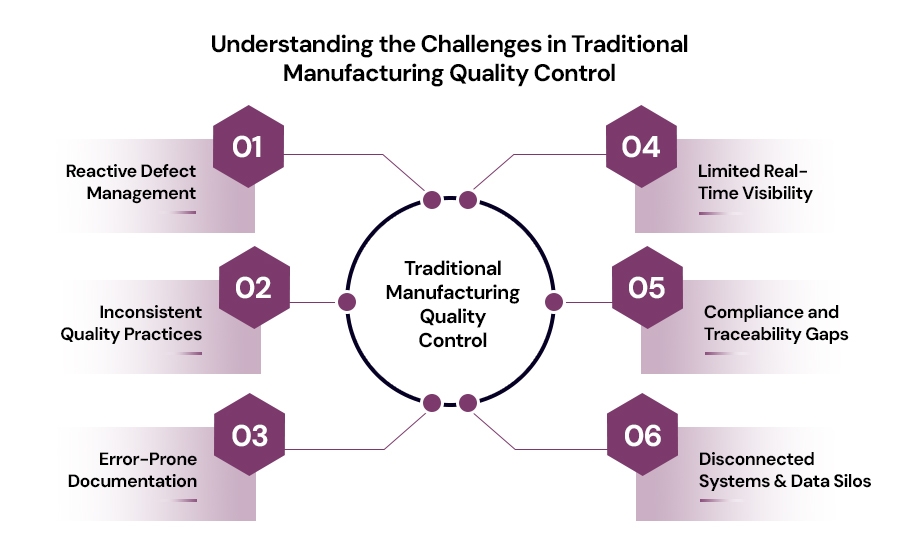
1. Reactive Defect Management
Traditional approaches typically identify defects only after they occur, often at final inspection or worse after customer delivery. This reactive stance leads to costly rework, production delays, and potential recalls that damage both finances and reputation.
2. Inconsistent Quality Practices
When inspections rely on manual processes and verbal instructions, quality standards vary across shifts, production lines, and individual inspectors. This inconsistency makes it nearly impossible to maintain uniform product quality or identify systemic issues.
3. Error-Prone Documentation
Paper-based checklists and spreadsheet logs are inherently unreliable. Records get lost, data entry errors occur, and information becomes difficult to analyze or retrieve during audits. The lack of standardized documentation creates compliance vulnerabilities.
4. Limited Real-Time Visibility
Without digital systems, quality managers lack real-time insights into inspection results, defect trends, or production line performance. This blind spot prevents timely intervention and makes trend analysis virtually impossible.
5. Compliance and Traceability Gaps
Manual tracking systems struggle to provide the comprehensive audit trails required by ISO certifications, industry regulations, and customer quality agreements. Demonstrating compliance becomes a time-consuming, stressful exercise.
6. Disconnected Systems and Data Silos
When quality control operates separately from production planning, inventory management, and supply chain systems, valuable data remains trapped in silos. This fragmentation prevents holistic analysis and informed decision-making.
These challenges don't just affect quality they erode profit margins, slow production cycles, and undermine competitive position in the market.
How Odoo ERP Implementation Revolutionizes Manufacturing Quality Control?
Odoo ERP's Quality Management module transforms quality control from a reactive burden into a proactive strategic advantage. Here are the key capabilities that drive this transformation:
1. Configurable Quality Control Points
Define inspection checkpoints at critical production stages raw material receiving, in-process verification, final product inspection, or pre-shipment validation. Inspections trigger automatically based on production workflows, eliminating manual scheduling errors and ensuring early defect detection before problems propagate downstream.
2. Standardized Inspection Templates
Create detailed inspection templates with measurement parameters, tolerance ranges, and clear pass/fail criteria. Standardization ensures every inspector evaluates products consistently, eliminating the inconsistency of manual, paper-based systems.
3. Seamless Manufacturing Integration
Link quality checkpoints directly to work orders and manufacturing routing. Failed inspections automatically pause production and route non-conforming items to rework. Mobile device support enables inspections at production stations while maintaining complete traceability.
4. Real-Time Dashboards and Analytics
Access real-time dashboards displaying inspection completion rates, pass/fail ratios, and defect trends by product, shift, or operator. This visibility enables rapid investigation of anomalies and identifies emerging issues before they become costly problems.
5. Complete Digital Documentation
Every inspection generates permanent digital records with timestamps, inspector identification, measurements, and photos. Complete traceability chains create bulletproof audit trails for regulatory compliance and eliminate error-prone paper-based documentation.
6. Automated Quality Alerts
Receive instant notifications when quality deviations occur. Configurable escalation rules ensure appropriate stakeholders receive timely alerts, dramatically accelerating response times and preventing defect propagation.
7. Supplier Quality Management
Track incoming material inspection results by supplier for data-driven performance evaluation. Supplier quality scorecards inform sourcing decisions, while automatic quality holds prevent problematic materials from entering production.
8. Continuous Improvement Tracking
Track corrective actions from initiation through verification. Quality data feeds process capability studies and statistical analysis, supporting preventive action programs that predict and prevent issues.
9. Scalable Architecture
The modular design adapts to various manufacturing complexities. Start with basic quality control and expand to advanced statistical process control, supplier management, or equipment calibration as needs evolve.
Together, these capabilities embed quality control directly into your production workflow, preventing defects early and driving continuous improvement.
Business Benefits of Implementing Odoo ERP for Quality Control
Organizations that implement Odoo's Quality Management System consistently report significant, measurable improvements across multiple dimensions:
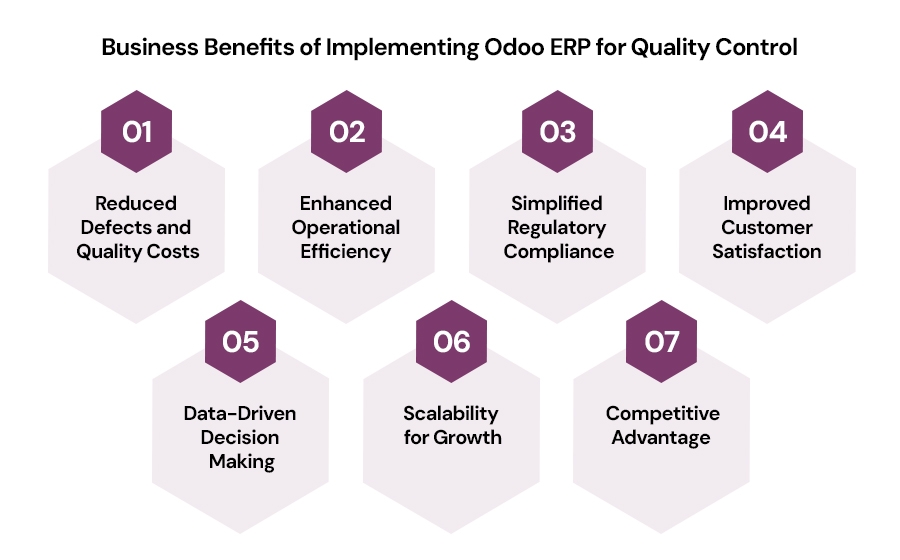
1. Reduced Defects and Quality Costs
Early defect detection prevents problems from propagating through production. Manufacturers typically achieve 25-40% reductions in scrap and rework costs within the first year of implementation.
2. Enhanced Operational Efficiency
Automated inspection scheduling and digital documentation eliminate manual quality administration tasks. Production flows more smoothly when quality checks are seamlessly integrated rather than disruptive interruptions.
3. Simplified Regulatory Compliance
Complete digital audit trails, standardized inspection procedures, and comprehensive documentation make regulatory audits and ISO certifications straightforward rather than stressful ordeals.
4. Improved Customer Satisfaction
Consistent product quality strengthens brand reputation, reduces customer complaints, and increases repeat business. Customers notice and value the reliability improvements.
5. Data-Driven Decision Making
Real-time dashboards and analytical reports enable quality managers and executives to make informed decisions based on facts rather than intuition or anecdotes.
6. Scalability for Growth
The modular architecture grows with your business. Start with basic quality control and expand to advanced statistical process control, supplier quality management, or equipment calibration tracking as needs evolve.
7. Competitive Advantage
Superior quality control capabilities differentiate your manufacturing operation from competitors, enabling you to win quality-conscious customers and command premium pricing.
Best Practices for Successful Odoo ERP Implementation
Maximize your return on investment by following these proven implementation practices:
1. Cross-Functional Collaboration
Involve representatives from quality, production, engineering, and operations when configuring quality control points and inspection procedures. Their diverse perspectives ensure practical, effective solutions.
2. Partner with Odoo Experts
Engage experienced Odoo implementation services providers who understand both the software and manufacturing quality management. Their expertise accelerates deployment and ensures optimal configuration.
3. Prioritize Change Management
Technology alone doesn't drive results people do. Invest in comprehensive training, clear communication, and ongoing support to ensure operators and inspectors embrace the new system enthusiastically.
4. Start with Pilot Programs
Begin implementation in a single production line or product family. Prove value, refine your approach, and build internal champions before expanding to your entire operation.
5. Establish Clear Metrics
Define specific, measurable objectives for your quality control implementation: defect reduction targets, inspection efficiency goals, or compliance improvement benchmarks. Track progress and celebrate successes.
6. Continuously Refine
Quality management isn't a set-it-and-forget-it project. Regularly review QC point effectiveness, update inspection procedures based on lessons learned, and leverage new Odoo features as they become available.
7. Integrate with Broader ERP Functions
Connect quality control with purchasing (supplier quality), inventory (quarantine management), production (work order holds), and sales (customer complaints) for comprehensive quality management.
Conclusion: Transform Your Manufacturing Quality with Odoo ERP
Odoo ERP implementation transforms manufacturing quality control from a reactive burden into a proactive strategic advantage. By embedding automated, standardized inspections directly into production workflows, manufacturers prevent defects early, maintain compliance efficiently, and drive continuous improvement. The integrated approach eliminates disconnected systems and manual processes while delivering real-time visibility and comprehensive traceability that enable measurable improvements in product quality and operational efficiency.
Frequently Asked Questions
1. What is Odoo ERP implementation and how does it enhance quality control?
Odoo ERP automates quality control by embedding inspection triggers into production workflows. Real‑time dashboards and integrated processes eliminate manual errors, detect defects early, and ensure traceability. This improves compliance, reduces delays, and drives continuous improvement across manufacturing operations.
2. How do I configure quality control points in Odoo ERP?
In the Quality module, create QC points with trigger conditions, define measurement types and acceptance criteria, then assign inspectors. Odoo’s interface ensures inspections are automatically prompted at the right stage, reducing errors and standardizing quality checks.
3. Can Odoo automate inspections at various production stages?
Yes. Odoo configures QC points at raw material receiving, in‑process checks, final verification, and pre‑shipment. Automated triggers ensure consistent inspections across all stages, improving compliance and reducing defects before products reach customers.
4. What are the tangible benefits for manufacturing operations?
Manufacturers achieve 25–40% scrap cost reductions, 30–50% faster inspections, improved compliance, and higher customer satisfaction. Odoo ERP also enables data‑driven continuous improvement, delivering ROI within 12–18 months.
5. How much does Odoo ERP implementation cost for manufacturers?
Costs typically range from $15,000 to $75,000 for small to mid‑sized manufacturers. ROI is achieved within 12–18 months through reduced defects, faster inspections, and improved efficiency.
6. Which Odoo modules work best with quality management?
Quality integrates with Manufacturing, Inventory, Purchase, Maintenance, and PLM. Together, these modules create a complete ecosystem for end‑to‑end quality control across the supply chain.
Transform Your Manufacturing Quality Today