



Your AWS bill just hit $180,000 this month up 40% from last quarter. Revenue grew by 15%. Your CFO wants answers. Your VP Engineering is scrambling to find what changed. And somewhere in your infrastructure, resources are burning money while your team ships features.
This isn't a failure of engineering discipline. It's what happens when cloud cost optimization becomes an afterthought instead of an engineering practice. The cloud promises pay-as-you-go flexibility, but without visibility into what drives your spend, "pay for what you use" quickly becomes "pay for what you forgot to turn off."
The good news? Engineering teams that treat cost as a first-class metric alongside performance and reliability typically reduce their cloud costs by 30-50% without sacrificing system quality.
This guide is for CTOs, VPs of Engineering, and Founders at product companies (1-500 employees, $50K+ monthly cloud bills) who need to reduce AWS and GCP costs by 30-50% without sacrificing performance, reliability, or engineering velocity. Here's the proven framework to get there.
| Industry | Avg. AI ROI | Primary Driver |
|---|---|---|
| SaaS | 200–400% | User retention |
| FinTech | 150–300% | Fraud detection |
| Healthcare | 120–280% | Scheduling & operations |
| ERP | 100–250% | Predictive maintenance |
What Is Cloud Cost Optimization?
Cloud cost optimization is the practice of maximizing business value from cloud infrastructure while minimizing unnecessary spend. It combines strategic resource management, architectural decisions, and continuous monitoring to ensure every dollar spent on AWS, GCP, or Azure directly contributes to product performance and business growth.
Unlike reactive cost-cutting, effective cloud cost optimization involves identifying mismanaged resources, rightsizing compute instances to match actual workload requirements, leveraging reserved capacity discounts, and most importantly connecting engineering decisions to their cost impact in real time.
Cloud Cost Optimization vs. Cloud Cost Management: What's The Difference?
Cloud cost management focuses on tracking, allocating, and reporting cloud expenditures across teams and projects. It answers "how much did we spend?" and "who spent it?"
Cloud cost optimization takes those insights further it answers "why did we spend it?" and "how can we spend smarter?" The goal isn't arbitrary cost reduction; it's aligning infrastructure spend with revenue-generating activities while eliminating waste that provides zero business value.
An increase in cloud costs isn't inherently problematic if it correlates with customer growth or new feature launches that drive revenue. The red flag appears when costs scale faster than the value they generate. For SaaS companies especially, maintaining healthy unit economics where cost per customer remains predictable as you scale directly impacts gross margins, investor appeal, and long-term profitability.
Effective cloud cost optimization requires cloud cost intelligence: granular visibility into which products, features, teams, and customers drive your spending, enabling data-driven decisions about where to optimize and where to invest more.
Why Engineering Teams Struggle To Control Cloud Costs
Most engineering teams lose 30-40% of cloud spend to seven preventable issues. Controlling cloud costs presents unique challenges even for experienced engineering organizations. Understanding these obstacles is the first step toward building sustainable optimization practices.
Lack of Visibility Into Cost Drivers
Without engineering-level visibility, tracking which services, features, or teams drive spending becomes nearly impossible. Most native cloud provider tools show you the "what" (EC2, S3, RDS charges) but not the "why" (which customer workload, which product feature, which deployment caused the spike). Cloud cost management solutions that provide this granular context are essential for meaningful optimization.
Poor Budgeting and Forecasting
Cloud spending is inherently dynamic, making accurate forecasting difficult. Development environments that should cost $5,000 monthly suddenly consume $30,000 because someone left a test cluster running. Without real-time cost data and predictive analytics, budgets become educated guesses that rarely survive contact with actual usage patterns.
Multiple Cloud Services With Different Pricing Models
Modern architectures span dozens of services compute, storage, databases, networking, serverless functions, managed Kubernetes. Each service has distinct pricing dimensions: per-hour, per-request, per-GB-transferred, per-IOPS. Tracking costs across this complexity without unified cloud cost management tooling creates blind spots where waste accumulates unnoticed.
Dynamic Pricing and Complex Billing Structures
Cloud providers adjust pricing based on demand, region, and commitment level. What cost $0.10 per GB last quarter might cost $0.12 this quarter. Hidden costs data transfer between availability zones, API calls, snapshot storage often surprise teams during bill reconciliation. These billing complexities make it easy to underestimate total cost of ownership.
Wasted Resources and Zombie Infrastructure
Development instances provisioned for a two-week project continue running six months later. Load testing infrastructure from last quarter's performance evaluation sits idle, accumulating charges. Without automated discovery and decommissioning processes, these "zombie resources" silently drain budgets.
Rapidly Changing Workloads
Traffic patterns shift. A marketing campaign triples load for three days. A major customer churns, reducing baseline requirements by 20%. Cloud infrastructure must adapt to these changes, but manual scaling leads to either over-provisioning (wasting money) or under-provisioning (degrading performance). This variability makes cloud cost optimization an ongoing challenge rather than a one-time fix.
Insufficient Governance and Training
Without clear policies about who can provision resources, set retention policies, or modify instance types, cloud spending becomes ungoverned. Teams lacking training in cloud cost optimization best practices make well-intentioned decisions that inadvertently increase costs choosing oversized instances "to be safe" or enabling verbose logging that generates terabytes of storage charges.
What Cloud Cost Optimization Delivers For Your Organization
Organizations that implement cloud cost optimization see nine measurable outcomes within 60-90 days. Implementing rigorous cloud cost optimization practices produces measurable benefits that extend well beyond line-item savings on your monthly cloud bill.
1. True Understanding of Cloud Economics
Knowing your total AWS or GCP spend for the month is surface-level information. Real cost intelligence means understanding exactly how much you spend supporting each customer segment, each product feature, each engineering team's projects, and each environment (production, staging, development). This granular visibility the foundation of effective cloud cost optimization reveals where you're overspending on low-value activities and where additional investment would generate outsized returns.
2. Systematic Cost Reduction Opportunities
Once you've mapped spending to specific business activities, two optimization paths become clear. First, you can eliminate cost centers that don't justify their expense decommissioning unprofitable features, consolidating redundant services, or rightsizing overprovisioned infrastructure. Second, you can refactor inefficient implementations to improve their price-performance ratio without removing functionality. Engineering teams typically find 30-50% savings through this systematic analysis.
3. Improved Gross Margins
For SaaS companies, Cost of Goods Sold (COGS) which includes cloud infrastructure costs directly impacts gross margins. High COGS compresses margins, limiting funds available for growth initiatives and making your business less attractive to investors. Cloud cost optimization reduces COGS as a percentage of revenue, improving margins that fund product development, sales expansion, and ultimately increase company valuation. Healthy margins aren't just good metrics; they're essential for sustainable growth and favorable financing terms.
4. New Revenue Stream Discovery
With detailed cost analytics, you discover which features customers use most intensively. This usage data reveals opportunities to package high-value capabilities as premium offerings or separate products. Similarly, analyzing cost per customer segment identifies your most profitable customer profiles, enabling more targeted marketing and sales strategies that prioritize high-margin opportunities.
5. Performance Improvements Alongside Cost Savings
Effective cloud cost optimization isn't about cutting corners it's about engineering efficiency. Rightsizing an over-provisioned database reduces costs while often improving query performance through better cache utilization. Eliminating unnecessary data transfers reduces latency and bills simultaneously. The goal is maximizing value per dollar spent, which frequently means better performance at lower cost.
6. Cost-Value Alignment Across The Organization
Cloud cost optimization enables you to map infrastructure spending to business dimensions that matter specific teams, departments, products, and services. This visibility allows strategic resource allocation, directing investment toward high-performing areas while reducing spend on underperforming initiatives. When costs transparently reflect business value, decision-making becomes data-driven rather than political.
7. Engineering Culture of Cost Awareness
Treating cost as a first-class metric alongside availability, latency, and error rates cultivates continuous improvement. When engineers see real-time cost impact of their architectural decisions and code changes, they naturally optimize for efficiency. This cultural shift, where cost awareness becomes embedded in daily engineering practice, delivers compounding benefits over time.
8. Accurate Cost Allocation and Chargebacks
Implementing cloud cost optimization dramatically improves showback and chargeback accuracy. Modern platforms track costs across tagged resources, untagged resources, and even untaggable shared services, then allocate them appropriately. Whether you're running on AWS, GCP, Azure, Kubernetes, or specialized platforms like MongoDB and Databricks, comprehensive cost allocation provides complete spending visibility and accountability across your organization.
9. Engineering Productivity Gains
When cost visibility, allocation, and anomaly detection are automated, your engineering and FinOps teams stop spending hours manually analyzing bills and tracking down spending anomalies. This recovered time gets reinvested in building features that attract and retain customers the work that actually drives revenue growth.
12 Cloud Cost Optimization Strategies Before Migration
These 12 strategies prevent 40-60% of post-migration cost surprises. Before migrating workloads to the cloud, implementing these strategies prevents costly mistakes and establishes optimization practices from day one.
1. Assess Your Current Infrastructure
Conduct a thorough inventory of existing resources, their utilization patterns, performance characteristics, and associated costs. This baseline assessment identifies which workloads are necessary, which can be eliminated, and which require optimization before migration. Understanding your current state prevents replicating inefficiencies in the cloud.
2. Familiarize Your Team With Cost Management Tools
Before migration, ensure your team understands AWS Cost Explorer, GCP Cost Management, or Azure Cost Management capabilities. These native tools provide spending visibility, usage patterns, and optimization recommendations. Early familiarity prevents post-migration surprises and enables proactive cloud cost management.
3. Right-Size Resources Based On Actual Requirements
Analyze current resource utilization to determine appropriate cloud instance types, storage tiers, and database configurations. Right-sizing before migration ensures you don't overprovision "to be safe," paying for capacity you'll never use. This upfront analysis typically reduces initial cloud costs by 20-30% compared to lift-and-shift approaches that replicate on-premises sizing.
4. Identify and Eliminate Unused Resources
Thoroughly inventory your infrastructure to find underutilized or idle resources that don't need to migrate. Decommissioning these before migration saves money immediately and simplifies your cloud environment, making ongoing cloud cost optimization easier.
5. Choose The Appropriate Pricing Model
Cloud providers offer multiple pricing options pay-as-you-go for variable workloads, Reserved Instances for predictable baseline capacity, Spot Instances for fault-tolerant batch processing. Selecting the right model for each workload component before migration can reduce costs by 50-75% compared to defaulting to on-demand pricing for everything.
6. Implement Automation From The Start
Establish automated policies for resource provisioning, scaling, and decommissioning before you migrate. Automation maintains optimal resource levels without manual intervention, preventing the gradual resource bloat that commonly occurs with manual management. This foundation makes continuous cloud cost optimization sustainable.
7. Plan For Data Transfer Costs
Data transfer between on-premises infrastructure and cloud environments, and between cloud regions, incurs significant charges that teams often underestimate. Calculate transfer costs for your migration plan and ongoing operations. For large datasets, offline transfer methods (AWS Snowball, GCP Transfer Appliance) can reduce costs dramatically.
8. Optimize Storage Solutions Upfront
Review your storage requirements and map them to cost-effective cloud storage tiers. Implement lifecycle policies from the start that automatically move infrequently accessed data to cheaper storage classes (S3 Glacier, GCP Coldline). This proactive approach to cloud cost management prevents expensive storage accumulation.
9. Establish Governance Policies
Define clear policies before migration about who can provision resources, spending limits per team, required tagging standards, and approval workflows for expensive instance types. Strong governance from day one prevents the cost overruns that occur when teams provision resources without constraints or accountability.
10. Train Your Team On Cloud Cost Best Practices
Ensure engineers, architects, and operations staff understand cloud cost optimization principles before migration. Training should cover right-sizing, reserved capacity, spot instances, and cost-effective architecture patterns. Well-trained teams make cost-conscious decisions naturally, preventing expensive mistakes that are difficult to unwind later.
11. Establish Regular Monitoring and Adjustment Cycles
Cloud environments are dynamic, and costs fluctuate with usage patterns, pricing changes, and business growth. Before migration, establish processes for weekly cost reviews, monthly optimization sprints, and quarterly strategic planning. This discipline, implemented from the start, maintains cost efficiency as your cloud footprint grows.
12. Plan Your Disaster Recovery Strategy For Cost Efficiency
Disaster recovery is essential, but it shouldn't double your infrastructure costs. Plan your DR strategy to balance protection requirements with budget constraints. Multi-region backups, automated recovery processes, and thoughtful use of lower-cost storage tiers protect your data without excessive spending.
Cloud Cost Optimization 17 Best Practices For Ongoing Success
Engineering teams that follow these 17 practices maintain 30-50% lower cloud costs year-over-year. Following these cloud cost optimization best practices creates a sustainable strategy that connects costs to specific business activities, enabling you to understand who, what, why, and how you're spending your cloud budget.
1. Set Up Your Account Architecture For Monitoring
If you haven't already, establish a master AWS Organization payer account (or equivalent in GCP/Azure). Ensure all member accounts roll their cost data into this master account, creating a single source of truth for total company cloud spend. Fragmented accounts make cost tracking exponentially harder as your organization grows.
Capture operational context alongside cost data. Sources like CloudWatch, CloudTrail, and VPC flow logs provide telemetry that explains what's happening in your system. Your team needs this context to correlate infrastructure activity with billing, enabling you to understand not just what you spent, but why you spent it.
Enable cost and usage reporting from day one. Historical spending data creates the baseline necessary to identify anomalous costs, forecast future spending accurately, and measure the impact of optimization initiatives.
2. Align Budgeting Processes With Business Goals
Controlling costs requires everyone to understand their budgets and the goals behind them. Rather than arbitrary budget allocation, engineering leaders should collaborate with executives and product leadership to define cost requirements based on business strategy.
Budget requirements should reflect how products and features will be packaged and delivered free tier, growth plan, or enterprise offering. These cost considerations need to be evaluated as tradeoffs throughout planning and development alongside other requirements like performance, reliability, and time-to-market. When cost is treated as an engineering requirement from the start, teams design cost-efficient solutions rather than expensive ones they later try to optimize.
3. Make Cost A First-Class Engineering Metric
Promote cloud cost optimization visibility throughout your organization, making it easy for developers to see and understand actual costs of their work. Keep cost top-of-mind as engineering decisions are made. To make cost data actionable, ensure it is current (real-time or near-real-time), has business context (connected to features and teams), can be measured objectively, and has clear definitions of acceptable versus problematic spending.
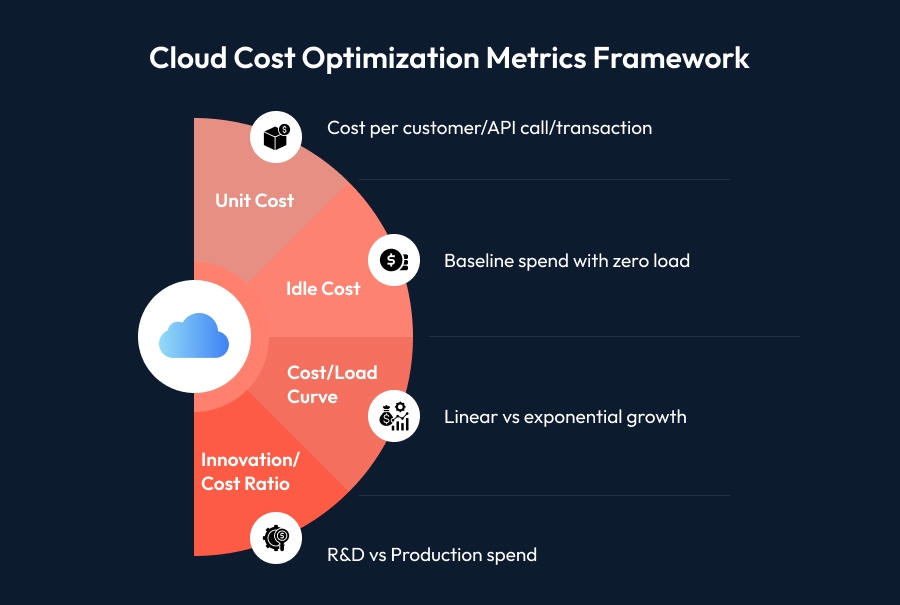
Several key metrics drive effective cloud cost optimization:
Unit Cost helps you understand the foundational economics of your business. Whether it's cost per API call, cost per report generated, or cost per active user, everyone should understand what factors influence unit cost and how it impacts profitability.
Key Insight: This metric informs decisions about resource allocation, customer pricing strategies, and return on cloud investment. Understanding unit economics is the foundation of sustainable cloud cost optimization.
Idle Cost represents your baseline infrastructure cost with zero customer load. This measures fundamental efficiency how much you're spending just to keep the lights on. Calculating idle cost helps determine whether architectural changes will deliver meaningful savings or just marginal improvements.
Shared Infrastructure Costs can offer economies of scale but complicate cost allocation across teams. Large organizations need clear strategies for charging back or accounting for shared services to maintain cost accountability without creating organizational friction.
Cost/Load Efficiency Curve reveals whether your unit costs grow linearly with customer base or exponentially. Exponential growth curves indicate architectural problems you'll eventually reach a crossover point where the system becomes unprofitable. Identifying this pattern early allows time to re-architect before it threatens business viability.
Innovation/Cost Ratio compares R&D spending to production operations costs. While R&D projects don't generate immediate revenue, they will eventually reach production. If cost hasn't been considered during development, the transition to production often reveals economically unsustainable implementations that require expensive refactoring.
4. Define Business-Critical Metrics Beyond Infrastructure
Everyone whose work impacts cost should understand business fundamentals and use this knowledge to drive decisions. Everyone should know the organization's most important goals at any given time customer growth for startups, margin improvement for mature companies, market expansion for growth-stage businesses.
When DevOps and engineering teams understand these business goals, they can make daily tactical decisions and strategic architectural choices that balance business needs with customer value.
| Metric | Business Questions It Answers |
|---|---|
| Cost per Feature | How much will building this feature cost? What incremental revenue will it generate? Should we build it now or later? How much are legacy decisions costing us? Which technical debt projects deliver the best ROI? |
| Cost per Customer & Segment | How much does a new customer cost in cloud resources? How much revenue does each customer generate? Are we profitable on certain customer types or sizes? Should we adjust pricing to reflect cost differences? |
| Cost per Application | What does running our app cost daily, monthly, and yearly? How does cost change with customer acquisition? What are our margins at the app level? |
| Cost per Team | How much is each team spending? Are there opportunities for resource sharing or economies of scale? |
| Revenue vs. Cloud Cost | What is the company making on the platform? What is projected annual revenue? What is the annual cloud cost? How will cloud cost grow or shrink relative to revenue? |
| Cost per Unit | What is the cost per unit? What is the revenue per unit? What are the margins? How do margins change as we scale? |
| Time to Market | How long does it take to get features to market? What does that cost in engineering hours? Can we reduce time to market and cost simultaneously? |
| Cost per Cloud Service | How much are we spending on compute, storage, and databases? When cost spikes occur, which services are affected? Are we using the right service for each workload? |
| R&D Cost | How much are we spending on research and development? What is the potential value of outcomes? Which R&D efforts justify their cost? |
| Cost Deviations | When cost spikes occur, what caused them? Is increased cost balanced by increased revenue? How do we prevent or stop unproductive spikes? |
5. Get The Right Data To The Right People At The Right Time
More data isn't always better information overload is often part of the cost management problem. Understanding which data types serve which team members, and reducing noise from extraneous information, improves decision quality.
What Engineers Need:
Baseline metrics and historical trends to identify when something breaks or anomalies arise
Ability to slice and dice data by resource, team, feature, and service
Real-time comparative data to diagnose and fix problems quickly
What Finance Needs:
Forward-looking projections: "How much will our cloud bill increase if we add six new customers?"
Budget forecasting: "What should we budget for cloud spend before fiscal year-end?"
Return on investment analysis: revenue generated from cloud infrastructure spending
Engineering and finance examine the same underlying data but need different views and organizational structures to answer their role-specific questions effectively.
6. Optimize Cloud Costs Throughout The Software Development Lifecycle
Cost should inform decisions at every stage of development, not just after a product launches.
Planning Stage: Teams should justify required budgets using cost data to inform product roadmap decisions and technical debt prioritization. This enables them to reduce unexpected spending and adjust budgets quickly when necessary. Integrating Product Strategy & Consulting considerations at this stage ensures cost planning aligns with market positioning and business goals.
Design and Build Stage: Teams need data to make cost-effective architecture decisions. They should report on planned spending and understand unit cost implications of their design choices. This is where Product Design and Prototyping intersects with cost planning, ensuring proposed solutions are economically viable before significant development investment.
Deployment and Operation Stage: Teams should quickly identify unpredicted spending and adjust accordingly. Effective Cloud and DevOps Engineering practices ensure this stage runs smoothly, with automated monitoring and response systems maintaining cost efficiency.
Monitoring Stage: Continuously reassess costs by team, product, or feature and report on operational expenditures and ROI segmented by business initiative. This ongoing analysis, supported by Software Product Development practices that emphasize observability, creates feedback loops that improve future decisions.
Every engineering decision has associated cost. By shifting cloud cost optimization left in the development lifecycle, each stage becomes an opportunity to maximize cloud ROI at the earliest possible point.
7. Make Timely Cost Decisions With Real-Time Analytics
When team members have access to the right data at the right time, they can make timely changes that impact both bottom line and product quality. You don't want to discover optimization opportunities weeks after they would have been most valuable.
Instead, observe cost indicators as they change in real time. You'll determine if costs are trending normally or if anomalous activities signal potential overspending. If you identify concerning patterns, take immediate action to prevent further losses. Alternatively, devote additional resources to support workloads that are driving higher earnings.
Achieving this requires cloud cost management solutions with real-time reporting and automated anomaly detection that alert appropriate teams immediately when spending deviates from expected patterns.
8. Use Cloud Costs To Inform Business Strategy
Most organizations default to charging customers based on metrics they can easily track. They "back themselves into" pricing strategies rather than selecting metrics that optimize business outcomes. This approach makes sense initially but often becomes problematic when pricing strategies aren't tied directly to cloud costs.
For example, a code scanning business might charge by megabyte scanned because that's easy to measure. But charging by lines of code might better reflect business value and cost structure. Customer growth can lead to nonlinear cloud cost increases, leaving the business struggling with compressed margins.
Critical Practice: Assign Dollar Costs to Every Feature
Every product feature should have a dollar cost associated with it. When DevOps instruments the application to measure these metrics from the beginning, the organization develops keen understanding of how much individual features and transactions cost. This visibility gives product teams flexibility to creatively price offerings based on clear, direct understanding of operational costs.
This level of cost transparency enables companies to create optimal business models and unlock new opportunities. When you use cost intelligence strategically, price becomes a competitive weapon that helps outpace competitors who lack this visibility.
9. Establish A Single Source Of Truth For Cost Data
With multiple dashboards monitoring data from multiple cloud vendors, making coherent decisions becomes difficult. Instead, establish a unified platform as your single source of truth for critical cost information.
A unified view provides teams with complete, end-to-end cost visibility. It also makes drilling into specific resources easy. With this visibility, teams can analyze cloud spend and usage per resource to gain granular insights like cost per customer, cost per feature, and cost per deployment the insights that drive effective cloud cost optimization decisions.
10. Rightsize Your Cloud Computing Resources Continuously
Right-sizing involves finding, reviewing, and modifying cloud resources to match the unique requirements of individual workloads and applications. You can rightsize compute instances, storage volumes, memory allocation, network throughput, and database configurations.
Because rightsizing in AWS alone offers over 1.7 million possible instance combinations, using cloud cost optimization tools to recommend optimal instance types for specific use cases saves significant analysis time. While rightsizing requires effort, the results extend beyond cost savings to improve performance, enhancing customer experiences while reducing spend.
11. Gradually Optimize With Cloud-Native Design Patterns
Most organizations migrate to the cloud through rehosting lift-and-shift migration that transfers on-premises systems to cloud environments without modification. Rehosting is fast and initially cost-effective, but it often moves on-premises inefficiencies to the cloud, where they generate runaway costs.
If time, budget, or skills aren't available to fully refactor legacy applications immediately, you can still make incremental design changes that eliminate inefficiencies causing cloud waste. Quality Software Product Development practices help teams avoid these architectural pitfalls, but even legacy systems can be gradually optimized through strategic refactoring that delivers compounding cost savings over time.
12. Keep Engineering At The Cloud Cost Optimization Table
Engineers can't help reduce costs if they aren't made responsible for costs. In SaaS, engineering activities development, deployment, testing, issue resolution often generate the bulk of cloud costs. Without engineering involvement, properly tagging resources, rightsizing them, or eliminating unused ones becomes impossible.
When engineering teams have the right cost data cost per product feature, cost per deployment, cost per customer they can determine which architectural decisions maximize business value at lowest cost to the company. This engineering-led approach to cloud cost optimization delivers sustainable results because the people making technical decisions understand their economic impact.
13. Leverage Reserved Instances For Predictable Workloads
Reserved Instances (RIs) are discount programs where you commit to using AWS, GCP, or Azure for one or three years in exchange for up to 75% savings compared to on-demand pricing. Analyzing your historical usage and cost patterns helps determine whether long-term commitments will deliver meaningful cloud cost optimization for your specific workload profile. For baseline capacity that runs continuously, RIs typically deliver excellent ROI.
14. Use Spot Instances For Fault-Tolerant Workloads
Spot Instances can save up to 90% compared to on-demand pricing, but they're not suitable for all workloads.
Use Spot Instances for:
Distributed databases with replication
Big data processing and machine learning training
CI/CD operations and batch jobs
Stateful applications designed to handle interruptions gracefully
Don't use Spot Instances for:
Production databases without replicas
Real-time customer-facing APIs
Applications requiring 99.9%+ uptime guarantees
Workloads that cannot tolerate interruptions
Spot Instance pricing and availability change dynamically, so you need monitoring and selection systems to identify the best combinations of price and availability that maximize savings while maintaining required capacity and performance.
15. Automate Cloud Spend Optimization
Identifying, reviewing, and monitoring ongoing rightsizing and cloud cost optimization opportunities is time-consuming and labor-intensive when done manually. Manual processes make it easy for teams to overlook opportunities or respond too slowly to changing conditions.
Modern cloud cost management solutions can rapidly scale resource usage down as applications require less capacity, automatically reducing costs. Some tools can terminate or hibernate instances based on predefined schedules or capacity thresholds. Both capabilities are difficult to implement reliably in real time through manual processes without risking performance degradation or outages.
16. Make Continuous Cloud Cost Optimization The Cultural Norm
Once you've made cost a first-class metric, nurture a cost-awareness culture by making cloud cost optimization continuous throughout the entire DevOps lifecycle rather than a periodic project.
Standardize cloud cost optimization best practices for cloud operations. Assign cost governance responsibilities to specific individuals or teams to ensure accountability, consistency, and continuous improvement. The goal is maintaining an efficient cloud system that doesn't accumulate unexpected costs that only become visible when monthly bills arrive.
17. Partner With Experts For Accelerated Cloud Cost Optimization
When internal resources are stretched thin or expertise gaps exist, partnering with specialized product engineering services providers can accelerate your cloud cost optimization journey. Expert teams bring proven frameworks, tooling expertise, and industry best practices that identify savings opportunities your team might miss. External expertise is especially valuable for organizations facing rapid growth, complex multi-cloud environments, or platform migrations where cost optimization experience directly impacts business outcomes.
Future Trends And Innovations In Cloud Cost Optimization
Cloud cost optimization continues evolving rapidly. Here are key trends shaping the future of cloud financial management.
Enhanced Focus On Cloud Spending Management
Managing cloud spending remains a top challenge for organizations, and this focus will intensify as cloud adoption deepens. Organizations will increasingly adopt advanced cloud cost management solutions and practices to gain better control over spending as cloud bills grow and CFO scrutiny increases.
Increasing Multi-Cloud Adoption
Multi-cloud strategies continue growing, with most enterprises now using multiple cloud providers. This trend drives demand for tools that manage and optimize costs across different platforms, providing unified cost visibility and enabling informed decisions about workload placement and resource allocation.
Growing Adoption Of FinOps Practices
Financial Operations (FinOps) importance in cloud cost management will continue rising. More organizations will adopt FinOps practices to improve financial accountability, enhance cost visibility, and drive cost-saving initiatives across cloud environments. FinOps represents the convergence of finance, operations, and engineering around shared cost optimization goals.
Sustainability And Carbon-Aware Computing
Sustainability is becoming a cost optimization focus. Tools will help reduce carbon footprint by optimizing cloud resource usage and selecting lower-carbon regions and services. Many organizations now include cloud efficiency as part of their sustainability goals, recognizing that resource optimization benefits both budgets and environmental impact.
AI-Driven Optimization
AI-driven cloud cost optimization represents one of the most exciting trends. AI tools provide sophisticated solutions for real-time cost monitoring, automated resource allocation, and predictive analytics that enable organizations to manage cloud costs more effectively. Machine learning algorithms can identify optimization patterns human analysts might miss, predicting cost spikes before they occur and automatically implementing remediation strategies.
How AspireSoftServ Helps Product Companies Optimize Cloud Costs
At AspireSoftServ, we help product engineering teams optimize cloud costs while maintaining performance and reliability. Our approach combines technical expertise with business outcomes to ensure your cloud cost optimization strategy aligns with growth objectives.
Our Cloud Cost Optimization Services Include:
Comprehensive Cost Analysis: We analyze your AWS and GCP cloud costs with engineering-focused metrics to identify specific optimization opportunities across your infrastructure, applications, and teams.
Engineering-Led Optimizations: Our team identifies practical optimizations that maintain SLAs while reducing unnecessary spend. We focus on changes that deliver immediate ROI without introducing risk to production systems.
DevOps Automation and Kubernetes Efficiency: We implement automation frameworks and optimize Kubernetes deployments to eliminate waste and improve resource utilization. Our Cloud and DevOps Engineering expertise ensures your infrastructure scales efficiently.
Long-Term Cost Ownership Integration: We embed cost ownership into your engineering workflows, ensuring sustainable optimization becomes part of your team's DNA rather than a one-time project.
Our strategy focuses on sustainable optimization, not short-term cost cutting. We combine technical depth with business outcomes, ensuring cloud spend aligns with product growth. Whether you need help with infrastructure optimization specifically or broader product engineering services, we approach every engagement with the same principle: efficiency should never compromise reliability.
The Path Forward: Making Cost Optimization a Continuous Practice
Cloud cost optimization doesn't end with a single audit or implementation. The most successful organizations treat it as a continuous practice integrated into every stage of the software development lifecycle.
Cloud costs don't spiral because teams are careless they scale because teams are focused on shipping features and maintaining uptime. The solution isn't to slow down; it's to make cost a visible, actionable engineering metric alongside latency, error rates, and availability.
Your AWS or GCP bill shouldn't grow faster than your product value. With the right visibility, tools, and engineering ownership, you can reduce cloud spend while maintaining or even improving performance and reliability.
When Should You Act on Cloud Cost Optimization?
If your AWS or GCP bill feels unpredictable, that's usually a sign of missing engineering-level visibility. Most teams benefit from a focused assessment when they notice:
Cloud costs growing faster than revenue or user growth
Monthly bills varying by more than 20% without clear explanation
Finance asking questions engineering teams can't easily answer
Non-production environments consuming 30%+ of total cloud spend
A short engineering-led review often reveals quick wins without touching production systems. The sooner you address these patterns, the easier optimization becomes.
Ready to Take Control of Your Cloud Costs?
A focused engineering-led review can identify optimization opportunities specific to your architecture. At AspireSoftServ, we've helped product companies across SaaS, FinTech, Healthcare, and Ecommerce reduce AWS and GCP costs by 30-50% while improving system performance.
Explore our product engineering services to learn how we help teams reduce cloud spend without compromising on what matters most reliability, performance, and velocity.
Start Your HIPAA Automation Project